Build a Star Pod
Everything from the original Star Pods page, plus the numbers for any size. Free to use. If you build one, we'd love to see it.
The geometry
A Star Pod is an icosahedron, the simplest geodesic dome there is, with its bottom point left off. What's left stands on a pentagon floor.
- 11 joints: a full icosahedron has 12; the missing one is where the floor is.
- 25 struts, every one the same length. No compound angles; the joint plates set the geometry.
- 15 triangles: a belt of 10 that makes the walls, and 5 more that meet at the peak.
Because every strut is identical, you can cut them all at once, and a pod scales just by changing that one length.
Sizes for any strut length
Worked out from the geometry, measured strut centre to centre. The plates and bolts add a few inches, which is why the 6 foot pod measures 8′6″ at the peak.
| Strut length | Wall height | Peak height | Across the base | Floor area | Skin area |
|---|---|---|---|---|---|
| 5′ | 4′3″ | 6′11″ | 7′8″ | 43 sq ft | 162 sq ft |
| 6′ (the standard pod) | 5′1″ | 8′3″ | 9′3″ | 62 sq ft | 234 sq ft |
| 7′ | 5′11″ | 9′8″ | 10′9″ | 84 sq ft | 318 sq ft |
| 8′ | 6′10″ | 11′ | 12′4″ | 110 sq ft | 416 sq ft |
For a different length L: walls are 0.85 L, peak 1.38 L, across 1.54 L, floor 1.72 L². Skin area is the 15 triangles with no overlap, so buy extra for seams and hems.
The 6 foot pod sleeps two comfortably. Bigger ones work as group space, a kitchen or a sound pod.
Parts for one pod
- 11 joint plates. The pods use the StarPlate system: galvanized steel hub plates made for equal-length boards, usually 2x4s. A full set is 12 plates; you'll have one spare. StarPlate Building Kit at Stromberg's.
- 25 struts of equal length, drilled to match the plates.
- 50 carriage bolts, 5/16″, two per strut, long enough to pass through the strut and plate with room for the nut and washer.
- A skin: a cut tarp, see the skin.
Assembly order
Follow the instructions that come with the plates for bolting and plate orientation. The order that builds this shape:
- Floor ring. Five struts and five plates make the pentagon on the ground.
- Wall belt. Ten struts go up from the floor ring in a zigzag, two from each floor plate, meeting at five new plates above.
- Upper ring. Five struts join those five upper plates into a second pentagon, rotated against the first.
- Peak. The last five struts run from the upper ring to the single top plate.
That's 5 + 10 + 5 + 5 = 25 struts and 5 + 5 + 1 = 11 plates.
The skin
The skin is what makes a pod livable in the heat. The best one reflects sun and blocks light: if light gets through, so does the heat.
Materials, roughly best to worst for heat:
- SilviCool, the tree-planting tarp fabric: white outside, shiny silver inside, nearly opaque.
- Black and white poly, 6 mil, white side out.
- Aluminet shade cloth over a lighter skin.
- White canvas or Tyvek, fine for mild weather.
Or make a funky patterned coloured pod. Just expect it to be warmer inside.
Tarp patterns
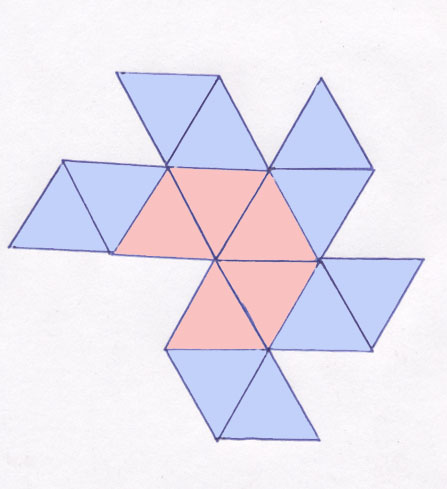
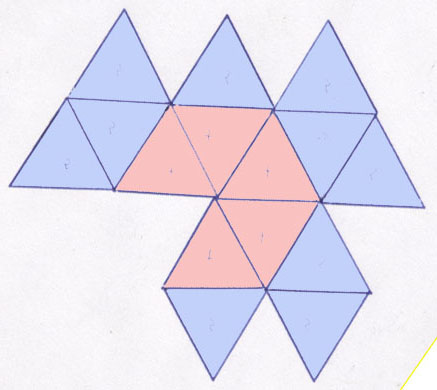
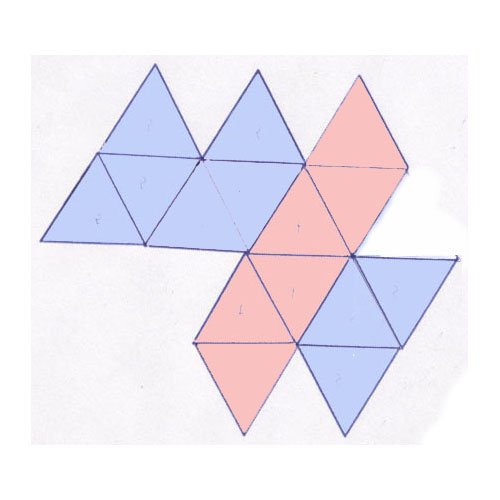
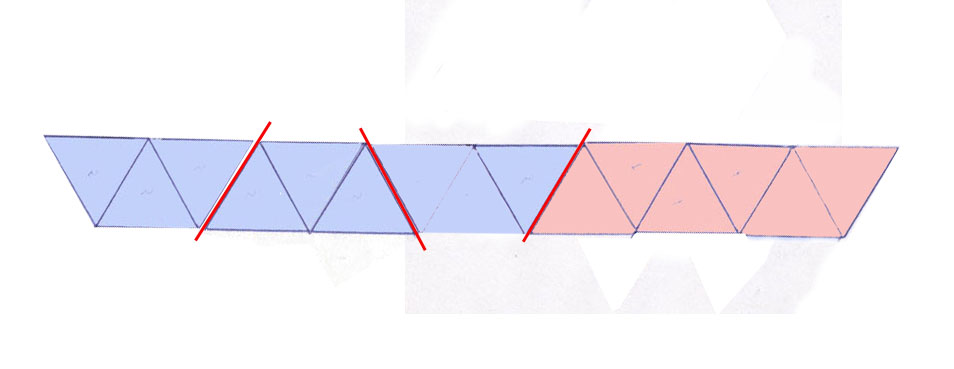
These are the original drawings from 2006. The idea is to wrap all 15 triangles with as few seams as possible. Closures are hook and loop: in the drawings, blue is loop and red is hook. Red goes on top, with the loop facing up.
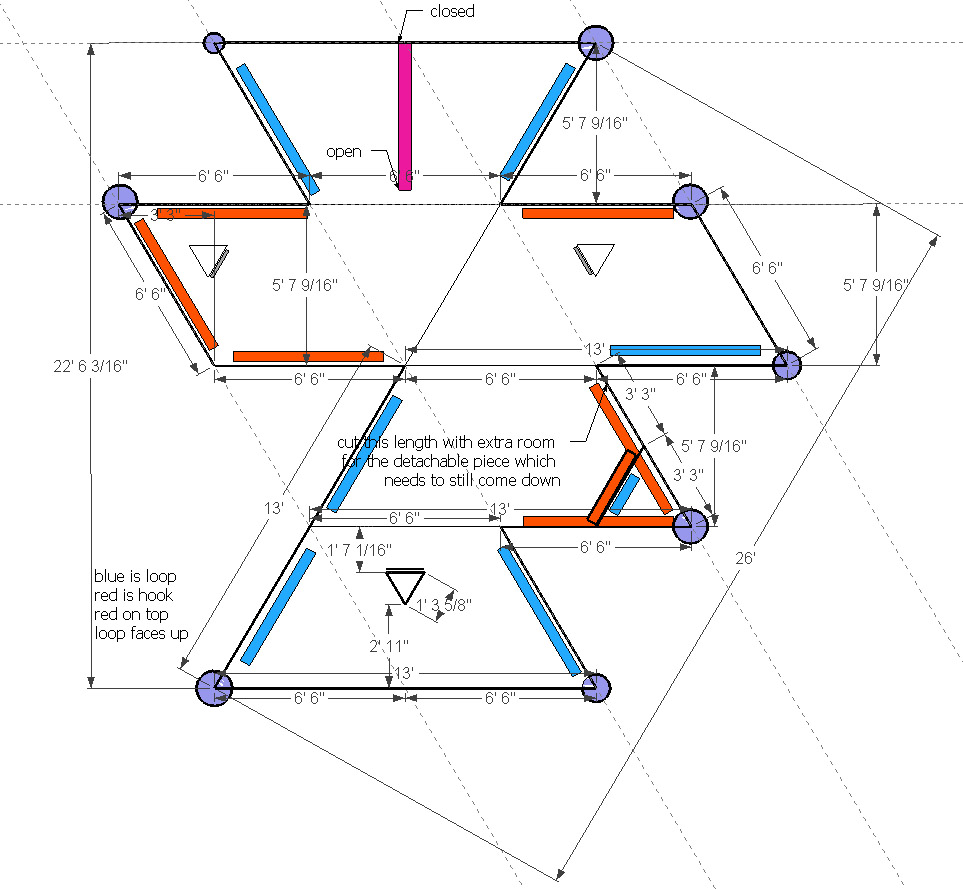
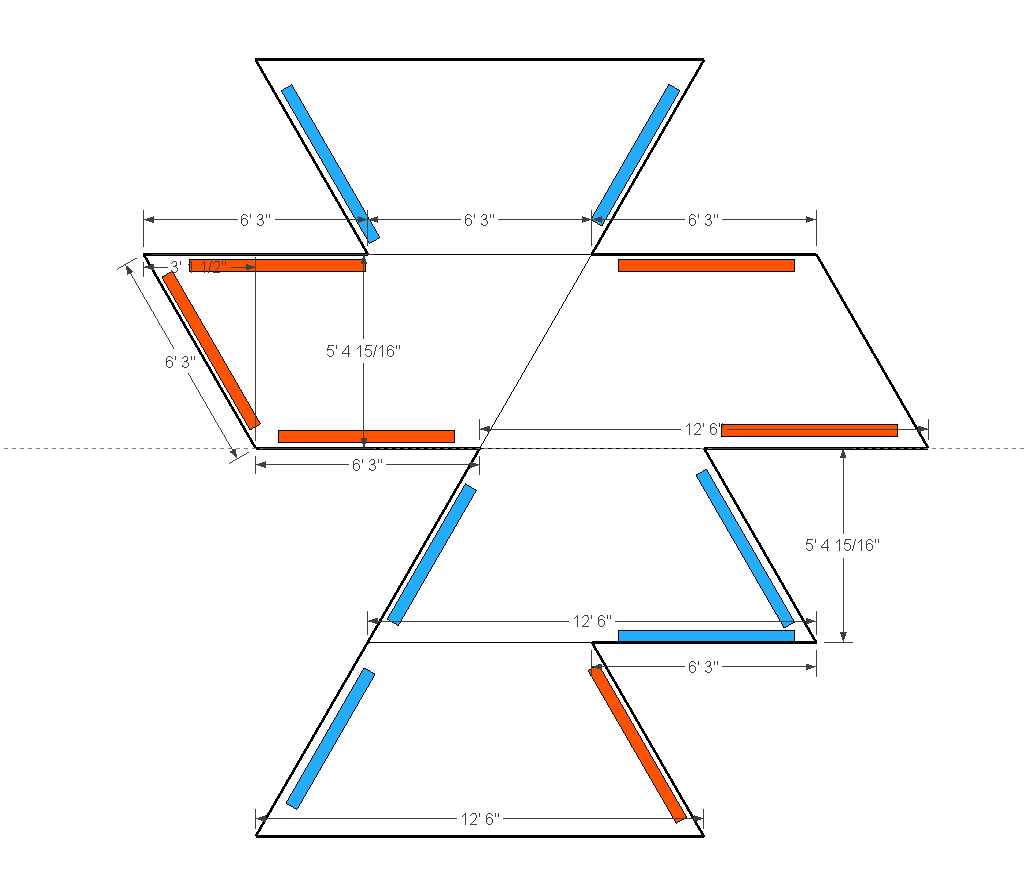
Configuration 3: the best so far
Three identical pieces and only three seams. Cut the larger piece in half and you get five identical pieces instead.
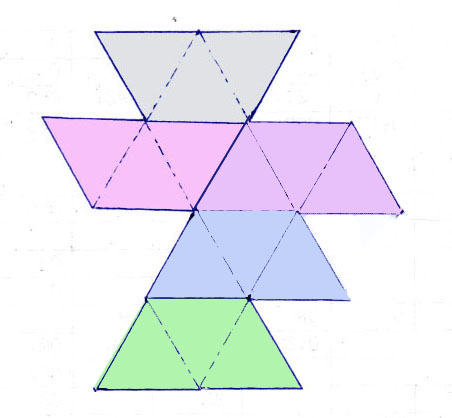
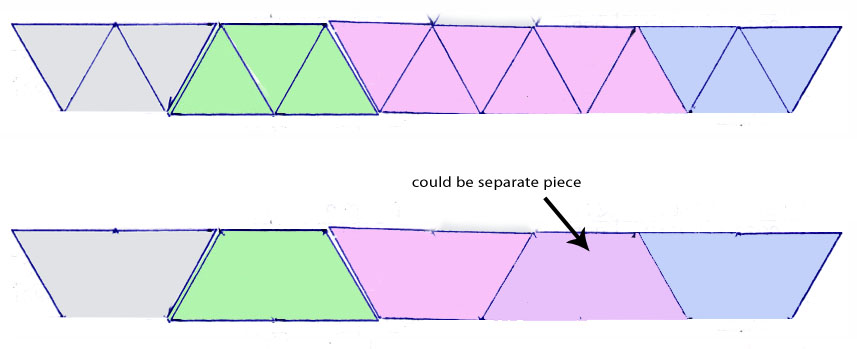
Other layouts that were tried
Ideas still on the list
- Solar lighting: a small panel and a multi-LED light inside.
- Venting: easier ways to move air, maybe windows. Every change adds cost, so they have to earn their place.
- Insulation for cold nights: rigid panels, such as honeycomb cardboard with reflective foil on one face and a waterproof layer on the other.
- A dish pod: a kitchen pod with a washbasin, solar-heated water, a drying rack and grey water filtration.
- A greenhouse: one pod has already spent time in a backyard doing exactly that.
Built one, or improved on any of this? Tell us through the form and pick "just keep me posted".